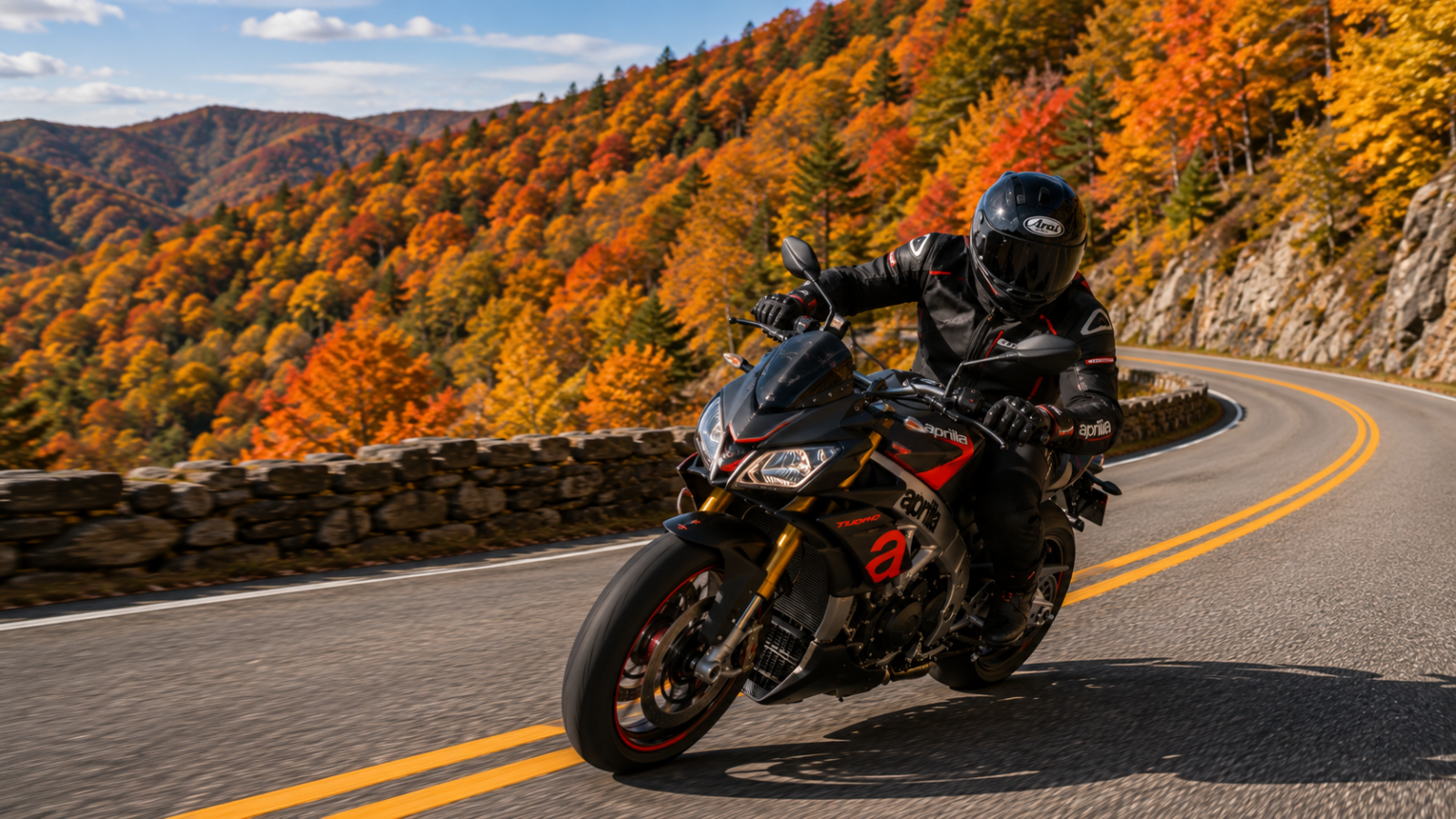
Here’s a confession. I’ve got a couple of enduros in the garage that haven’t seen the dirt they were built for in longer than I’d like to admit — the road bikes have taken over the calendar. Lately I’ve been thinking about changing that, and if you’ve had the same thought, or you’re curious about trying adventure and dual-sport riding for the first time, this post is partly my own note-to-self and partly a guide to what’s actually out there in the North Georgia scene right now.
Because a lot has changed since I last paid close attention. The middleweight ADV class has gone genuinely mainstream. Backcountry Discovery Routes has documented a full 350-mile North Georgia loop that didn’t exist when I first got into any of this. The community, always centered around Two Wheels of Suches for pavement, now runs some serious organized dual-sport events out of the same hub. It’s a good moment to get into the mountains on tires that can handle both surfaces.
Why North Georgia Is a Real ADV Destination
Talk to riders who’ve done the Trans-America Trail or one of the BDRs, and they’ll tell you the Southeast is often overlooked in the ADV conversation, which mostly focuses on the West. That’s a mistake. North Georgia sits on top of one of the densest publicly accessible forest road networks east of the Mississippi.
The Chattahoochee-Oconee National Forest covers more than 866,000 acres of mountain country. Threading through it is a system of Forest Service roads — graded gravel, primitive two-track, seasonal roads that get rougher the further you go — that runs into the hundreds of miles. Add in the designated OHV trail systems, the connectivity between the same small towns that anchor the pavement scene (Suches, Blairsville, Ellijay, Helen), and the fact that most of it is rideable most of the year, and you’ve got real backcountry-riding country without needing to fly to Utah.
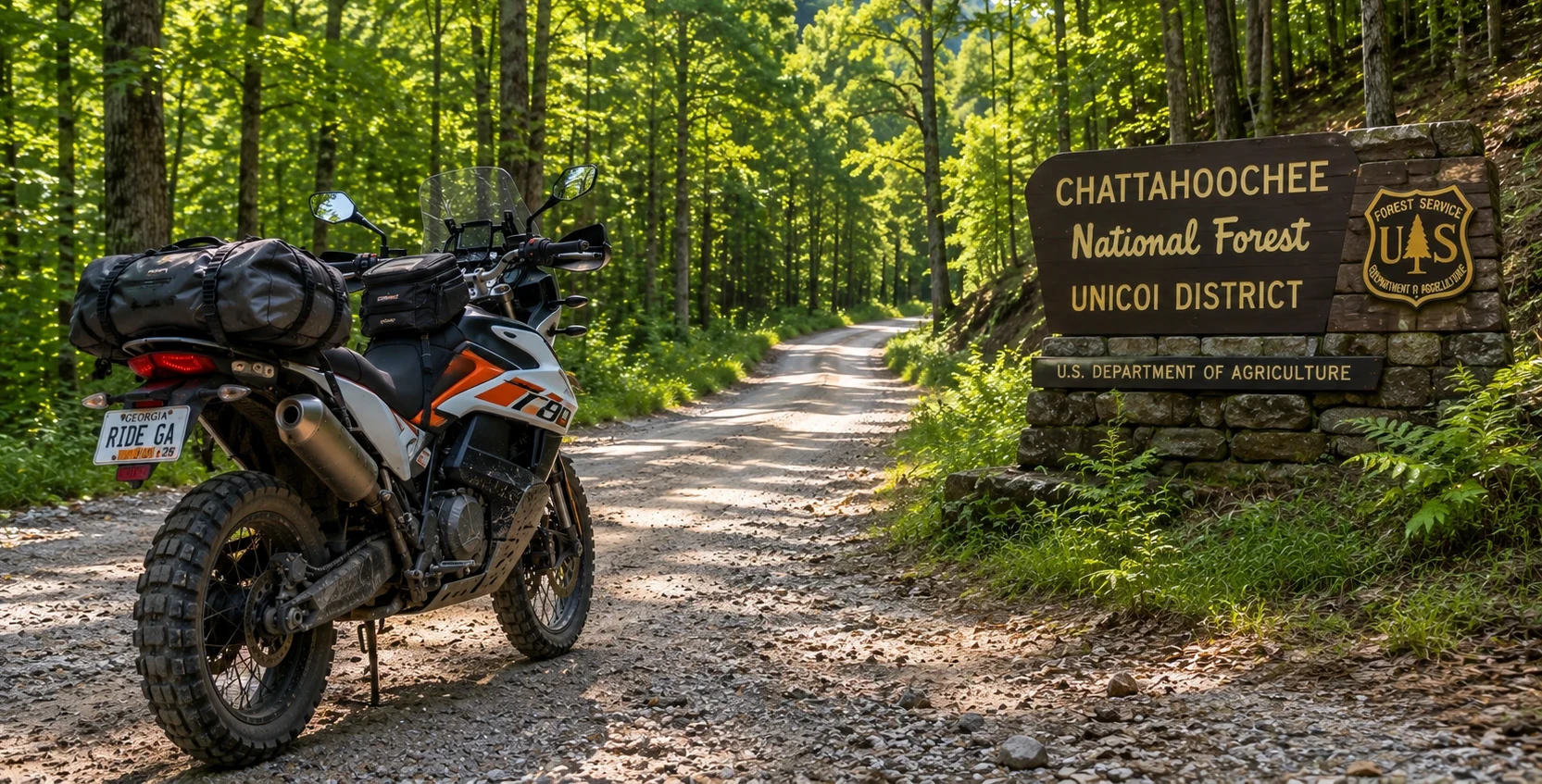
The Marquee Route: Chattahoochee BDR-X
If you want the one route to know, this is it. The Chattahoochee BDR-X is a 350-mile documented loop through the North Georgia mountains published by Backcountry Discovery Routes, the well-known nonprofit that maps and releases ADV routes across the country. Their “X” designation is for shorter, loop-style routes as opposed to the point-to-point BDRs.
The loop combines graded forest roads, primitive two-track sections, and stretches of scenic pavement to tie it all together. It passes through Ellijay, Dahlonega, Suches, and Helen, so lodging and fuel are never too far off. The route crosses the Appalachian Trail multiple times, includes several creek crossings, and has both easier gravel sections and rougher technical stretches — enough range that riders on 1200cc adventure bikes and 400cc dual-sports can both find something to enjoy, though the big bikes will work harder through the technical parts.
Best window is roughly March through December. Winter brings enough freezing and wet conditions to make some sections messy, and some forest roads have seasonal closures.
The Community: GARTRA and Two Wheels of Suches
The Georgia Recreational Trail Riders Association (GARTRA) is the club that anchors the organized dual-sport scene. Established in 1992 as a volunteer-run nonprofit, GARTRA hosts two annual dual-sport rides based out of Two Wheels of Suches: The Hooch in June, and the Fall Foliage Ride in October or November.
Both are designed to accommodate mixed skill levels, with routes that include easy gravel, forest service roads, rocky climbs, and optional advanced sections into legitimate single-track inside the OHV trail systems. Riders come in from Tennessee, Alabama, the Carolinas, and further afield. Registration fills fast — the 2026 Hooch went out to more than 200 riders — so if you’re interested, get on their mailing list well before registration opens.
Two Wheels of Suches itself, already the pavement hub, does double duty as the ADV hub. Between the GARTRA events and the general community that gathers there through the season, it’s the natural first stop for a rider getting reacquainted with the scene.
OHV Areas: When You Want Dirt Only
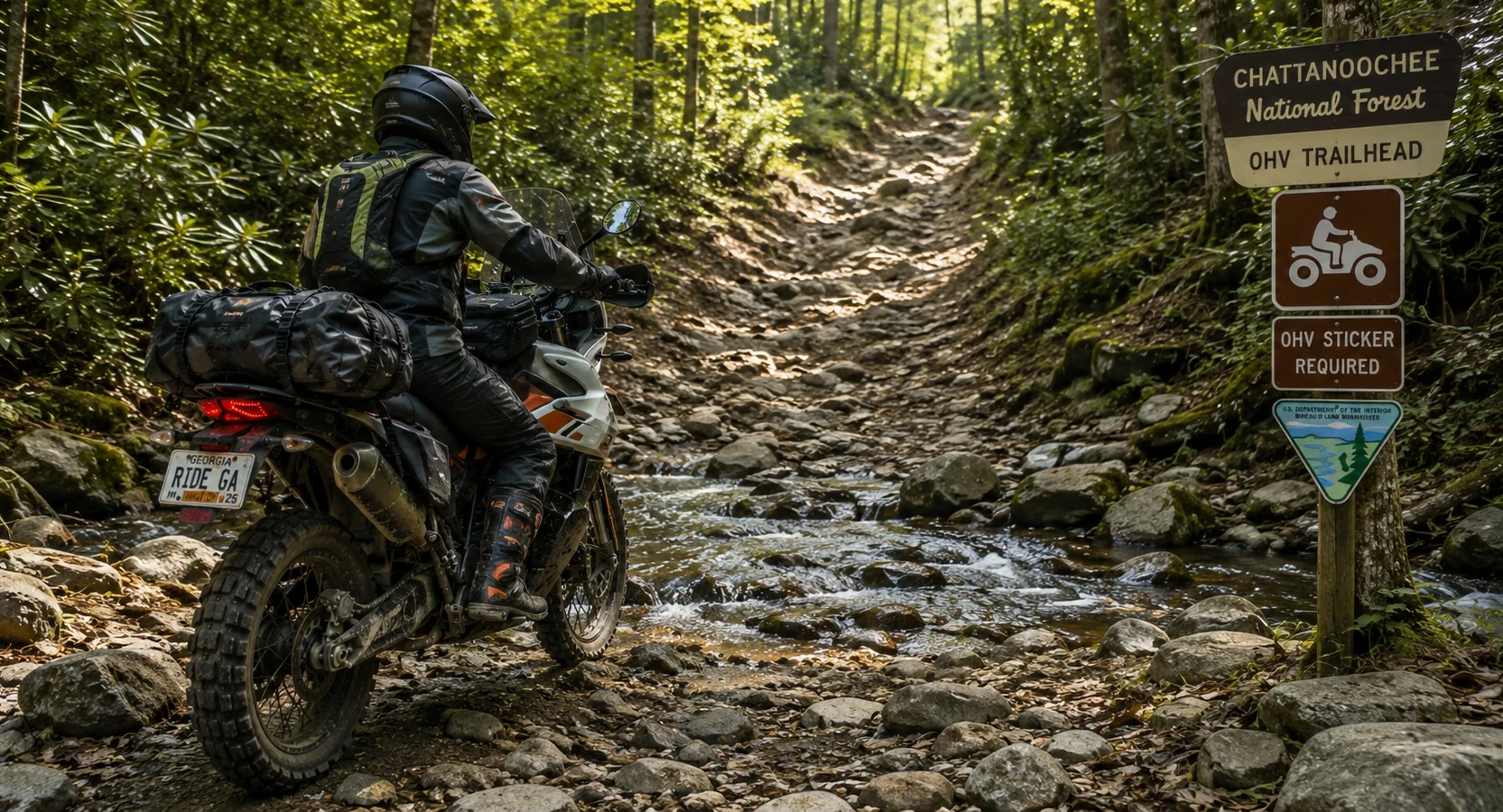
Separate from the Forest Service road network are the designated OHV (Off-Highway Vehicle) trails. These are single-track and technical two-track areas set aside specifically for off-road riding, and they’re a different animal from the graded gravel roads.
Three OHV areas matter for North Georgia riders:
Whissenhunt OHV Trails — about 11 miles of trails near Dahlonega, ranging from easy to most difficult. Closed January 1 through March 31 for winter resource protection.
Davenport Mountain OHV Trails — 5.9 miles of trails about 12 miles west of Blairsville, with an easy section suitable for newer riders plus more difficult sections and views of Nottely Lake.
Houston Valley OHV Trails — 25 miles just west of Dalton, the largest Forest Service OHV system in Georgia. Closes after significant rain events to protect the trails.
All three require a day pass, currently $5 per operator per day, available digitally through Recreation.gov or at listed vendors. Motorcycles and ATVs 50 inches or narrower only — no full-size 4x4s.
The Legal Basics You Need to Know
This is the section people usually skip and then get in trouble over. Read it.
Forest Service roads in the Chattahoochee-Oconee are open only to street-legal, registered vehicles with a licensed driver. That means your dual-sport or adventure bike must have valid registration, a license plate, DOT-legal equipment, and you need a driver’s license. Unregistered dirt bikes, ATVs, and side-by-sides are not allowed on Forest Service roads.
OHV trails are different — that’s where non-street-legal machines belong, but they require the day pass mentioned above, and riders must stay on the marked designated trails.
Wilderness areas are closed to all motorized vehicles. The Cohutta Wilderness in the northwest corner of the forest is the big one — roughly 37,000 acres where no motorcycles are permitted, period. Don’t ride into wilderness even by mistake; it’s a federal offense and rangers do enforce it.
Motor Vehicle Use Maps (MVUMs) show every legally rideable Forest Service road and are updated by the USFS. Download the current one for free from the Chattahoochee-Oconee National Forest website before you go — road status changes.
Seasonal closures happen for weather, wildlife, and maintenance. Check the current forest alerts before you commit to a route.
Bike and Tire Considerations
The market has grown substantially since my last dual-sport days. The current sweet spot for North Georgia terrain is generally considered the middleweight ADV class — Yamaha Ténéré 700, KTM 890 Adventure, Suzuki V-Strom 800DE, Honda Transalp 750 — because they handle both pavement stretches and rougher gravel without punishing you when things get tight.
Bigger 1200cc adventure bikes (BMW R 1300 GS, KTM 1290 Super Adventure, Honda Africa Twin) will do the BDR-X, but expect to be working hard through the technical sections. Smaller dual-sports (Kawasaki KLR650, Suzuki DR-Z400, Honda XR650L) remain excellent choices, especially if you want to take on the single-track OHV areas.
If I had to name the honest first purchase for anyone coming back to this or starting fresh: tires. A genuine 50/50 dual-sport tire like the Continental TKC 70 or a knobbier option like the Motoz Tractionator will change what you can do on your existing bike far more than a bigger bike will.
Basecamps
For a weekend or a week, three natural bases: Two Wheels of Suches for the community hub, on-site restaurant and campground at the GA-60/GA-180 intersection; Mulberry Gap in Ellijay, a genuine ADV-specific basecamp on the western end of the BDR-X with cabin lodging, meals included, and on-site trail access; and standard hotel or cabin options in Blairsville, Blue Ridge, or Helen if you want a town base and don’t need the campground or community angle.
A Suggested Starter Ride
If you’re getting back into it — or trying it for the first time — I’d skip the full BDR-X and start with a moderate day ride. Base out of Two Wheels of Suches, head northeast toward the Cooper Creek WMA on the graded forest roads, work through the Duncan Ridge area with a short section of rockier terrain, and connect back via GA-180. You’ll cover 60 to 80 miles, get a real taste of the terrain, and be back with plenty of daylight to sit around and decide whether you’re ready to commit to the full loop.
3 Key Takeaways
1. The scene is mature and well-documented. The Chattahoochee BDR-X gives you a 350-mile loop with a real map behind it, GARTRA runs organized events out of Two Wheels of Suches, and the OHV areas are actively maintained. It’s a real destination, not a scattered set of secondhand tips.
2. The legal rules are strict and worth respecting. Forest Service roads: street-legal, registered, licensed. OHV areas: day pass, marked trails only. Wilderness areas: no motorized vehicles ever. Check the current Motor Vehicle Use Map and forest alerts before you ride.
3. You don’t need the biggest bike, but you probably need better tires. Middleweight ADV bikes are the sweet spot for the terrain, and a real 50/50 dual-sport tire will do more for your riding than an engine displacement upgrade.
3-Point Summary
What you’ll ride: The Chattahoochee BDR-X (a documented 350-mile loop), hundreds of miles of graded Forest Service gravel in the Chattahoochee-Oconee, and three OHV areas — Whissenhunt, Davenport Mountain, and Houston Valley — when you want single-track.
Who to ride with: GARTRA hosts The Hooch in June and the Fall Foliage Ride in fall, both based at Two Wheels of Suches. Mulberry Gap in Ellijay is a genuine ADV basecamp on the western end of the BDR-X.
What to know before you go: Forest roads require street-legal bikes with licensed riders. OHV areas require a $5/day pass. Wilderness areas are closed. Grab the current MVUM from the USFS site and check alerts for seasonal closures.
The Bottom Line
The North Georgia ADV and dual-sport scene has matured into something well worth building a trip around. For a rider returning to the class — as I’m considering — or coming to it fresh, the combination of documented routes, an active community, and legal access to hundreds of miles of forest roads makes this a genuine destination without needing to leave the Southeast.
I’ll be spending some time this fall figuring out whether the feel comes back the way I remember. If it does, expect more posts from this side of the site.
Have you ridden the BDR-X or one of the GARTRA events? Drop a note in the comments — I could use the fresh intel.