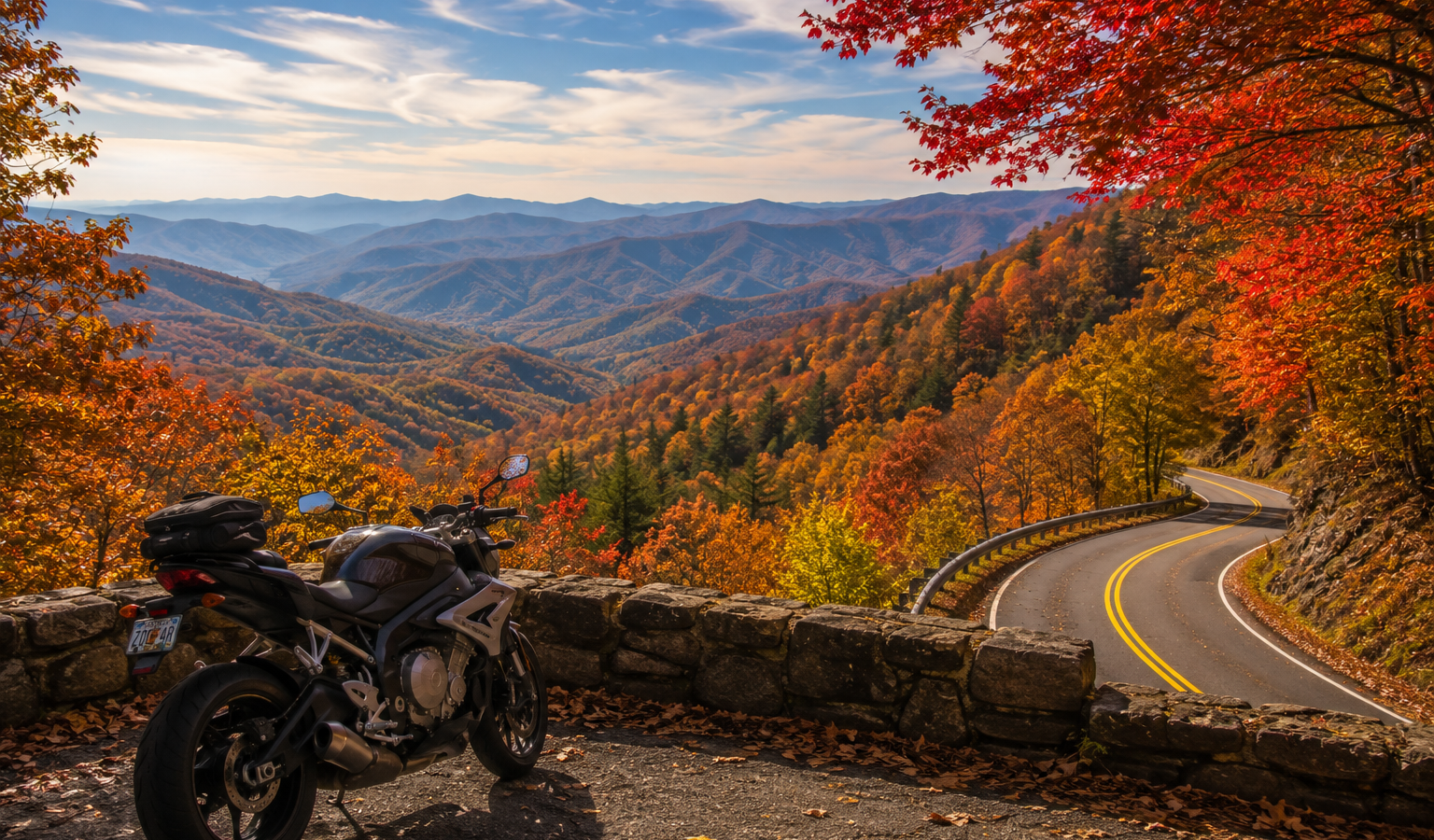
The most common question I get from riders planning a trip up here is some version of “when should I come?” There’s no single right answer. The mountains have four genuinely different riding seasons, and which one is “best” depends on what you’re after. Fall gets the most press, but it isn’t always the best time to actually ride. Spring can be spectacular but sometimes messy. Summer offers the longest days and the worst crowds. Winter has some of the most beautiful empty roads and the highest risk.
This guide breaks down what each season actually gives you — the weather, the road conditions, the crowds, the events, the gotchas — so you can plan around your priorities instead of just showing up in October like everyone else.
Why Timing Matters More in the Mountains
Mountain weather is its own thing. Elevation changes of 2,000 feet or more in a single ride are common up here, and every 1,000 feet you climb subtracts roughly 3 to 5°F from the temperature at your handlebars. A 75°F morning in Helen can be 60°F at Hogpen Gap and colder still at Brasstown Bald. Cell service is spotty enough that weather apps often lie. Storms build fast in warm months, and cold snaps in cool months can catch you 30 miles from anywhere.
Understanding what each season actually does to conditions matters more here than it does riding in flatter country. It changes what gear you carry, what routes you plan, and how early you get on the bike.
Winter (December – February)
Start with the season most riders write off, because it’s more nuanced than “just don’t.”
The honest picture: December through February brings the coldest temperatures, the shortest days, and the worst road conditions. Freezing rain, snow at elevation, salt and sand residue after weather events, wet leaves that never dried — all real. Some Forest Service roads have seasonal closures. Wildlife, especially deer, is more active in the early mornings.
But — and this is the part nobody talks about — winter also brings the emptiest roads in the entire riding calendar. On a sunny 55°F Saturday in February, you can ride GA-348, Wolf Pen Gap, and Blood Mountain and see maybe a dozen cars total. The tourist crowds in Helen are gone. The light is beautiful.
If you want to ride winter here, watch the forecast obsessively, ride only on clear-dry days after several dry days in a row, add real cold-weather gear (heated grips at minimum, heated gear at best), and check bike-critical items — battery, tires, fluids — before every ride. Stay off high elevation on marginal days. What’s fine at 1,500 feet can be ice at 4,000.
Spring (March – May)
The reset. Bikes come out of garages, the community re-emerges, and the mountains transition from bare to green fast. March is still often cold and wet — the “mud season” for gravel riders. April warms up, brings wildflowers and brilliant new leaves, and daylight stretches. May is arguably the single best riding month of the year: 70s and low 80s, low humidity, no crowds yet, no bugs yet.
Watch for: late frosts at elevation that can catch you off guard, afternoon storms building faster than expected, pollen coating the roads on the first sunny days (surprisingly slick), road cyclists returning to the pavement in force, and waterfalls at their peak flow.
Bear activity picks up in April as they come out of dens. Deer are birthing fawns and mothers can be aggressive. Ride expecting wildlife more than usual.
The Georgia Mountain Rally in Hiawassee happens in early May — a natural way to bookmark the season’s official kickoff.
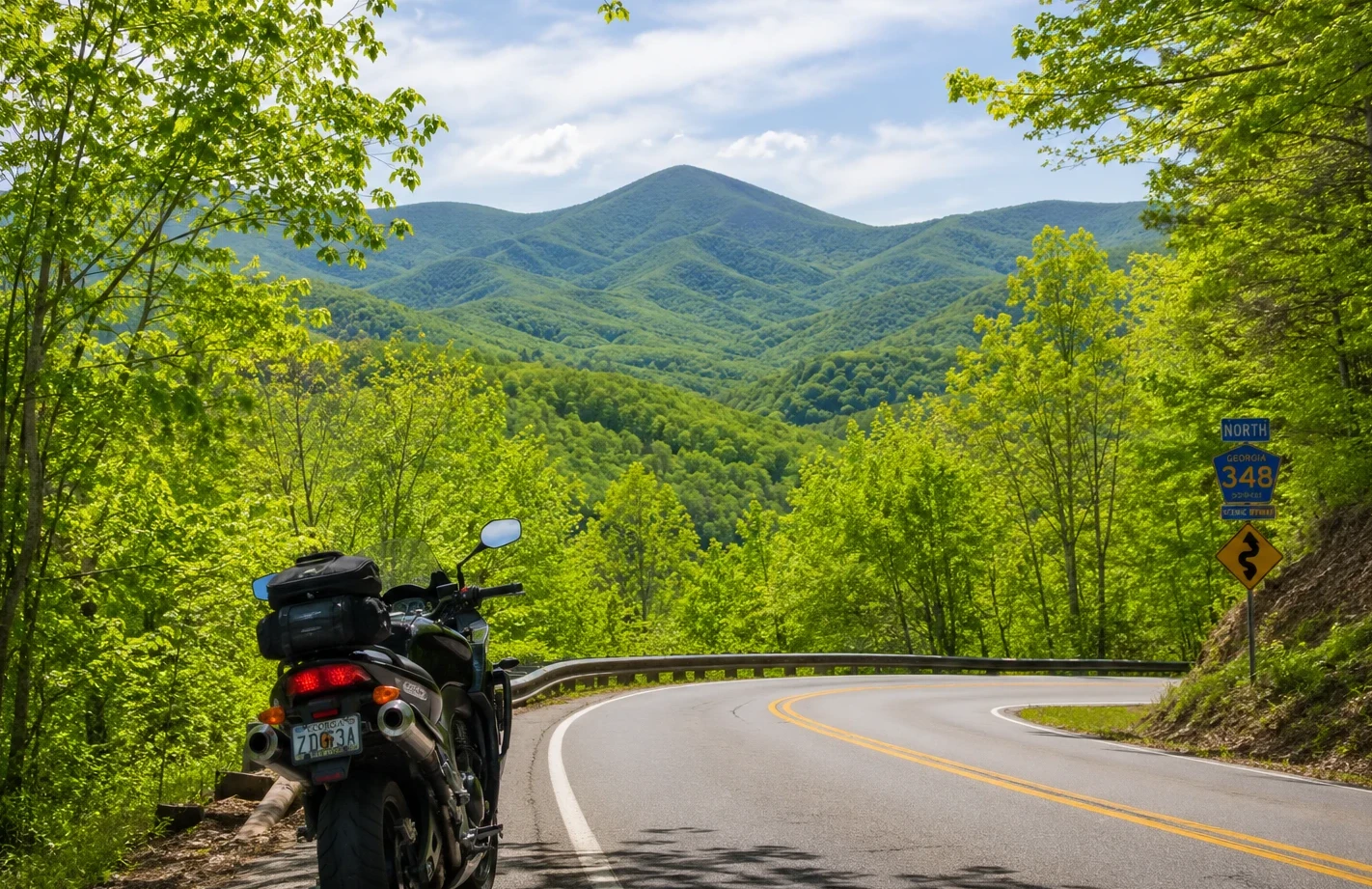
May is arguably the single best riding month of the year. Warm, dry, and empty.
Summer (June – August)
Long days, hot valleys, cool elevation, thunderstorms, and crowds.
The valleys — Helen, Blairsville, Cleveland — hit the mid-90s in July and August with high humidity. But every 1,000 feet you climb takes off 3 to 5°F, so at Brasstown Bald it’s often 15 to 20 degrees cooler than at the trailhead you started from. This is why so many summer rides in North Georgia start early: leave at 6 or 7 AM, ride the mountains through midday, be back by early afternoon before the thunderstorms build.
Thunderstorms are the big story of summer up here. They build fast, hit hard, and often catch riders who thought “the forecast said afternoon storms” meant 4 PM when they actually rolled in at 1 PM. Watch the sky, not just the phone.
Tourist crowds peak. Helen is packed on weekends. Brasstown Bald has waits for parking. Locals ride weekdays and early mornings for a reason.
Events cluster in early summer: the Biker Nation Reunion Rally in Helen (early June), and GARTRA’s dual-sport Hooch ride (mid-June) out of Two Wheels of Suches. If you’re coming for one of these, book lodging well ahead.
Wildlife shifts: snakes on gravel roads (basking), bugs everywhere, ticks in tall grass.
One personal note. If you ride a bike with aggressive ergonomics and no wind protection — like the Aprilia Tuono I’ve been on most this season — factor in that summer heat plus no fairing can turn a fun mountain run into an endurance event by midday. Plan for shorter, earlier rides in July and August, or take a bike that gives you a little more airflow and a more relaxed posture.
Fall (September – November)
The season everyone comes for. And they’re not wrong — fall in North Georgia is spectacular. But it comes with real trade-offs.
The good: cool mornings, warm afternoons, low humidity, and gradually thinning tourist traffic through September. Then the color explosion peaks around late October to early November depending on elevation and how the year went. Photographers and riders alike come for this.
The bad: peak leaf season, roughly the last two weeks of October and the first week of November, brings some of the worst traffic of the entire year. Brasstown Bald, the scenic overlooks, all the marquee roads — expect waits, expect slow traffic, expect to share every scenic road with someone driving 30 in a 55.
The deer rut kicks off in October and runs through November. Deer are on the move, less predictable, and more likely to bolt into roads. Dawn and dusk are highest risk. This is the season to be especially attentive coming around blind corners on rural roads.
Wet leaves are the other fall hazard, especially in the low-angle late-morning sun that doesn’t dry road surfaces. Cornering on leaf-covered pavement is genuinely slippery.
Days shorten fast. Rides that felt easy in September end in the dark by early November.
Events: GARTRA’s Fall Foliage Ride in late October or early November — a genuine highlight of the season if you’re in the ADV world.
The classic recommendation: ride mid-September through early October for the best weather-to-crowd ratio, then go for peak color starting mid-October if you can accept the crowds.
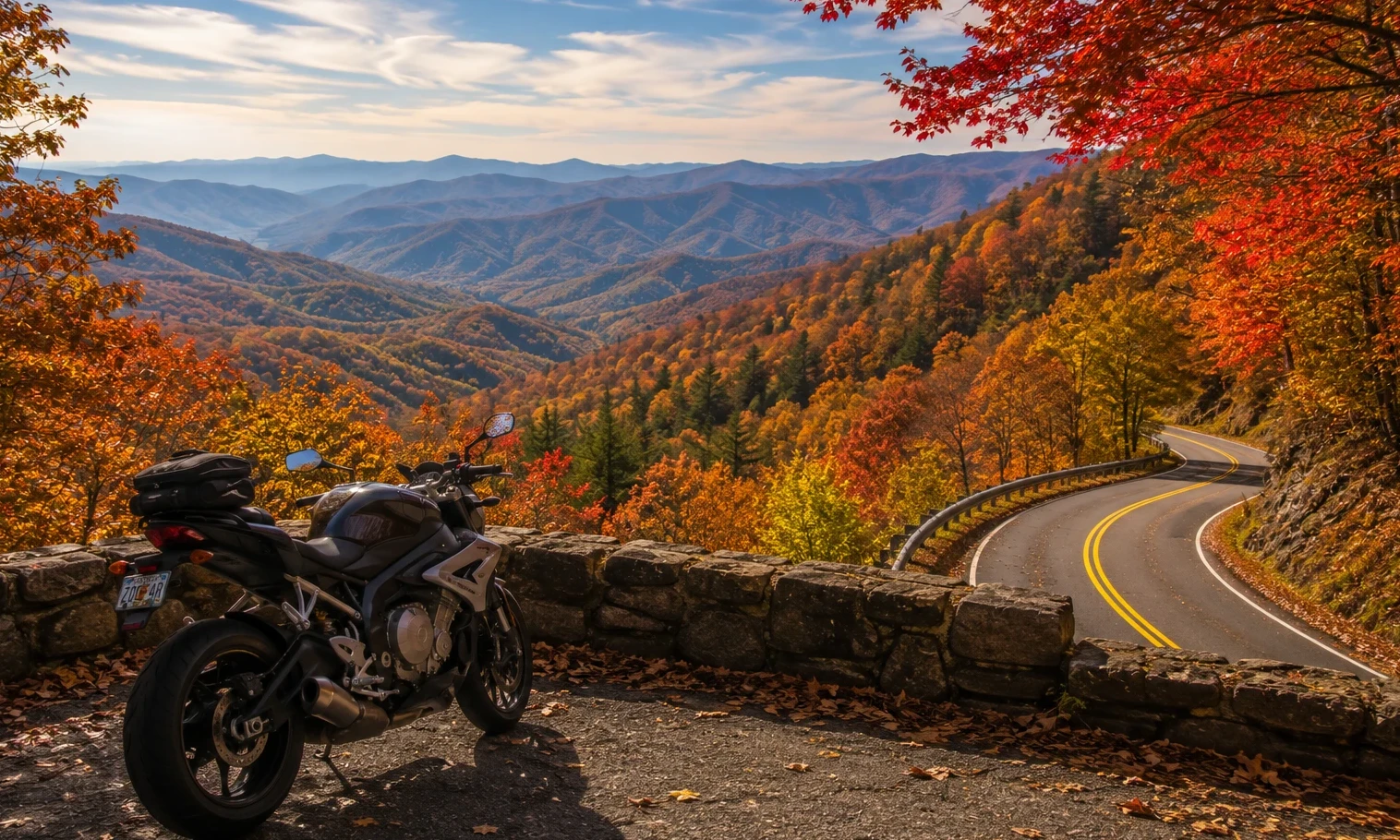
Peak fall color is spectacular. The trade-off is the traffic that comes with it.
Year-Round Considerations
Regardless of season, some things stay constant up here. Elevation changes conditions faster than you’d expect — a 30-minute ride can drop 20°F. Cell service is unreliable; download offline maps and don’t bet the ride on your weather app. Wind exposure on high ridges (Brasstown Bald, Blood Mountain summit area) can be significant even on calm valley days. And fuel gets sparse the deeper you go into the mountains — Helen, Blairsville, Hiawassee, and Dahlonega are your reset points.
My Take
If you asked me for one recommendation, I’d say plan for mid-September through early October for the best overall balance — warm-enough weather, empty-enough roads, and color starting to turn without full peak-season crowds. Second choice: early May, for the same reasons but pre-summer.
But every season has its case. Winter has its empty-road magic if you’re willing to gear up. Peak fall is spectacular if you accept the crowds. Summer’s early-morning rides at elevation are a real pleasure. There’s no wrong time to ride North Georgia — only wrong expectations for the time you pick.
3 Key Takeaways
1. Elevation matters more than the calendar. Even a 60°F valley morning can be sub-40°F at the summits. Pack layers year-round and don’t trust the forecast for the town you started in to describe the road you’re riding.
2. Storms and light. Summer thunderstorms build faster than the forecast says — watch the sky, not the app. Fall daylight shortens quickly — plan return times generously.
3. Wildlife shifts by season. Deer with fawns in spring, snakes and bugs in summer, deer in rut in fall, and reduced daylight visibility in winter. Ride expecting company on the roads and expect it to change with the calendar.
3-Point Summary
Best overall windows: Mid-September through early October, or early May. Great weather, thin crowds, low risk.
The marquee season: Mid-October through the first week of November for peak fall color, if you can accept the traffic that comes with it.
The overlooked season: Winter isn’t always ridable, but when it is, the roads are empty in a way no other season matches. Gear up, ride the right days, and stay off high elevation on marginal ones.
The Bottom Line
There’s no wrong season to ride North Georgia — only wrong preparation for the season you pick. The mountains are always here, always beautiful, and always changing. Pick your priorities, watch the weather, and pack layers.
What’s your favorite season to ride up here? Drop it in the comments — the answers vary more than you’d think.